
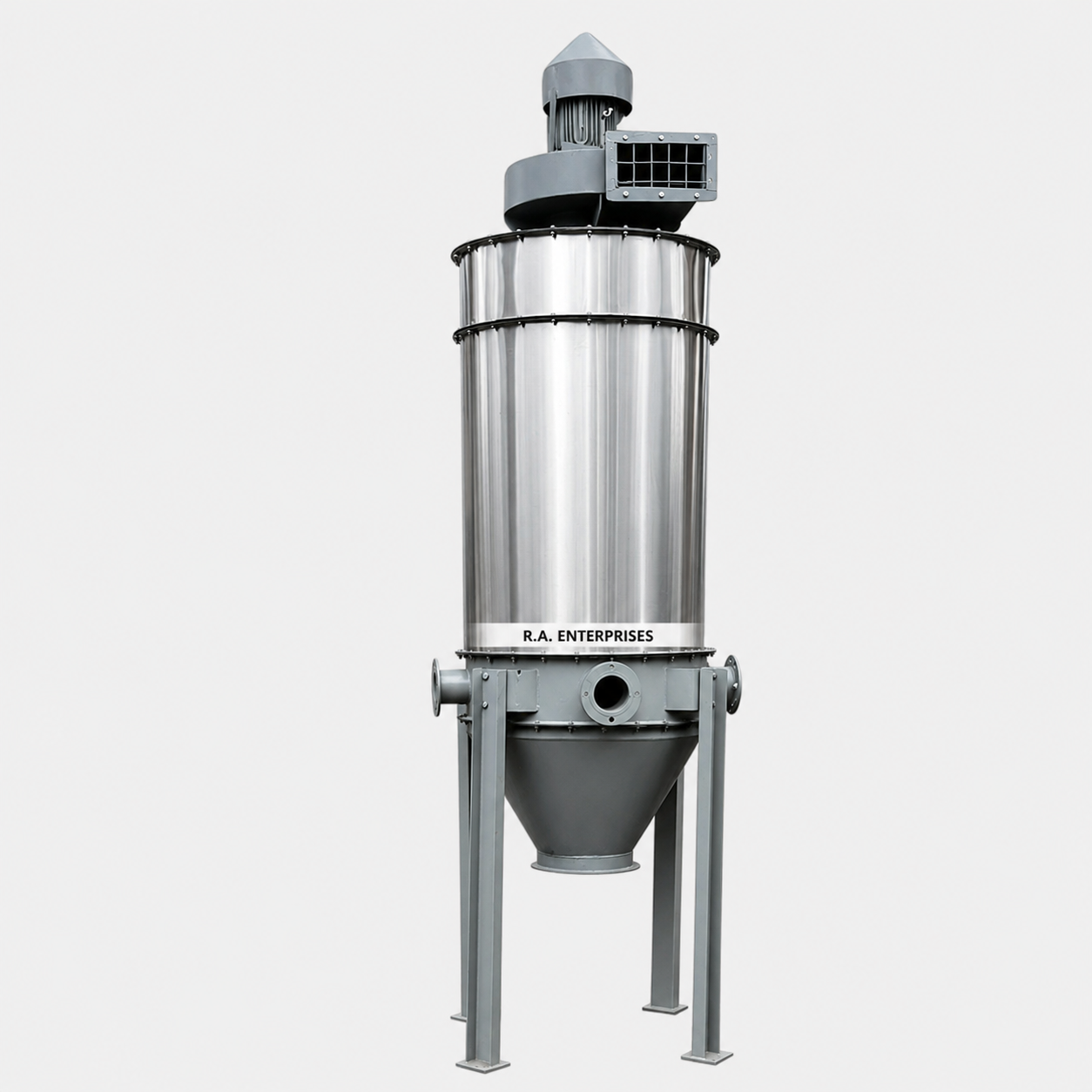
14 Bag Ground-Mounted Silo Dust Collector – Vibratory & Pulse Jet Type
Product Overview
The 14 bag ground mounted silo dust collector from R.A. Enterprises, Pune is designed for efficient dust filtration during cement and fly ash silo filling and industrial dry bulk material handling. Available with vibratory or pulse jet cleaning, the system provides reliable filtration and convenient ground-level maintenance.
Function
Dust-laden air enters the dust collector through connected ducting and passes through the filter elements. Fine dust particles are retained on the filtration surface while filtered air is released from the system. Accumulated dust is periodically removed from the filter elements using the selected vibratory or pulse jet cleaning system.
Key Features
Cleaning Mechanism:
- Available with Vibratory Cleaning Type or Pulse Jet Cleaning Type.
- Vibratory cleaning mechanically agitates the filter elements.
- Pulse jet cleaning uses controlled compressed-air pulses.
- Cleaning system can be selected according to application requirements.
Filtration & Performance:
- 14 filter element / bag configuration.
- Approx. 24.5 m² filtration area in the current reference configuration.
- Reference airflow up to approximately 1,500 m³/hr.
- Filter media can be selected according to dust characteristics and application.
- Designed for effective filtration of fine industrial dust.
Design & Maintenance:
- Compact and rugged industrial construction.
- Ground-level installation provides convenient maintenance access.
- Easy filter inspection and replacement.
- Quick-access arrangement for routine servicing.
- Weather protection arrangement for filter and cleaning components.
- Designed for easy preventive maintenance.
System Integration:
- Suitable for connection with cement and fly ash silos.
- Can be integrated with centralized dust collection systems.
- Ducting and inlet connections can be customized according to plant layout.
- Suitable for new installations as well as replacement applications.
- Single or multiple dust-point arrangements can be engineered as per application.
Applications
- Cement Storage Silos
- Fly Ash Storage Silos
- Ready-Mix Concrete (RMC) Plants
- Concrete Batching Plants
- Cement Handling Systems
- Fly Ash Handling Systems
- Dry Mortar Plants
- Limestone Powder Handling
- Mineral Powder Storage Systems
- Industrial Powder Handling Plants
- Compatible Dry Bulk Material Handling Systems
Benefits
- Helps control dust generated during silo filling and material transfer.
- Ground-level installation simplifies inspection and maintenance.
- Helps reduce airborne dust and material loss.
- Improves cleanliness around the silo and batching plant area.
- Vibratory and pulse jet cleaning options are available for different applications.
- Easy filter element access reduces maintenance time.
- Suitable for centralized dust collection arrangements.
- Customizable according to plant layout and operating requirements.
Why Choose R.A. Enterprises?
- Industrial dust collector manufacturer in Pune, Maharashtra.
- Customized dust collector design according to application requirements.
- Vibratory and Pulse Jet Dust Collector options available.
- Manufacturing support for silos and bulk material handling equipment.
- Dust collector and silo accessories available from a single source.
- Technical support for selection and system integration.
- Supply support for industrial projects across India.
| Specification | Current / Recommended Description |
|---|---|
| Product | Ground Mounted Dust Collector |
| Configuration | 14 Bag / 14 Filter Element Configuration |
| Cleaning System | Vibratory Type or Pulse Jet Type, depending on selected model |
| Installation | Ground Mounted |
| Filtration Area | Approx. 24.5 m² – current reference value; confirm with final model |
| Reference Airflow | Up to approx. 1,500 m³/hr – subject to filter selection and operating conditions |
| Housing | Compact cylindrical stainless-steel construction; final material grade as per specification |
| Filter Elements | 14 filter elements / bags; filter media selected according to application |
| Compressed Air | Not normally required for vibratory cleaning; required for pulse jet configuration |
| Particle Filtration | Current page reference states particles below 10 microns; final performance depends on selected filter media and operating conditions |
| Outlet Dust Emission | Current page reference states below 50 mg/Nm³; project-specific requirement must be confirmed with final filter selection |
| Operating Temperature | Current page reference: 10°C–150°C; final allowable temperature depends on filter media, seals and equipment configuration |
| System Integration | Single or multiple silo / dust-point configuration subject to system design, airflow and ducting arrangement |
| Typical Materials | Cement, fly ash, limestone powder, mineral powders and compatible dry bulk materials |
| Typical Applications | RMC plants, concrete batching plants, storage silos and industrial powder handling systems |
Note: Technical specifications may vary depending on material characteristics, pneumatic filling rate, dust loading, filter media, cleaning arrangement and project requirements. Final values should be confirmed in the approved quotation or technical datasheet.
Enquire Now
Frequently Asked Questions
1. What is a ground mounted dust collector?
A ground mounted dust collector is an industrial dust filtration system installed at ground level and connected to silos or other dust-generating equipment through suitable ducting. Ground-level installation provides convenient access for filter inspection, cleaning and routine maintenance.
2. Why is a dust collector required on a cement silo?
During pneumatic cement filling, displaced air carries fine cement dust from the silo. A properly selected cement silo dust collector filters this dust-laden air, helping control airborne emissions, reduce material loss and maintain a cleaner plant environment.
3. How does a ground mounted silo dust collector work?
Dust-laden air is transferred through ducting to the ground mounted collector and passes through filter elements. Dust remains on the filtration surface while filtered air exits the system. Collected dust is periodically removed using the selected vibratory or pulse jet cleaning mechanism.
4. What is a 14 bag dust collector?
A 14 bag dust collector uses fourteen filter elements or bags for industrial dust filtration. The required capacity depends on filtration area, airflow, dust loading, material characteristics, ducting and operating conditions rather than only the number of filter bags.
5. What is the difference between vibratory and pulse jet cleaning?
A vibratory dust collector mechanically vibrates the filter assembly to remove accumulated dust. A pulse jet dust collector uses short controlled bursts of compressed air to clean the filters. The appropriate system is selected according to operating requirements.
6. Does a pulse jet ground mounted dust collector require compressed air?
Yes. A pulse jet dust collector requires a suitable compressed-air supply for filter cleaning. The required air pressure, pulse frequency, solenoid valve arrangement and control system depend on the final collector design and application.
7. Does a vibratory dust collector require compressed air?
A vibratory cleaning system normally uses an electrically operated vibration mechanism and generally does not require compressed air for filter cleaning. This can make it suitable for installations where a compressed-air cleaning system is not preferred.
8. Can a ground mounted dust collector be used for fly ash?
Yes. A ground mounted dust collector can be designed for fly ash silo and fly ash handling applications. Filter media and system parameters should be selected according to particle characteristics, temperature, moisture, dust loading and operating conditions.
9. Can this dust collector be used in an RMC plant?
Yes. Ground mounted dust collectors are suitable for RMC plants and concrete batching plants where cement, fly ash and compatible dry powders are pneumatically conveyed, stored or transferred.
10. Can a ground mounted dust collector be connected to multiple silos?
A centralized ground mounted dust collection system can be engineered for multiple silos or dust collection points where the plant arrangement permits. Airflow, simultaneous filling conditions, duct sizing and overall system capacity must be considered during selection.
11. What are the main advantages of a ground mounted dust collector?
Important benefits include convenient ground-level maintenance, easier filter replacement, centralized dust collection possibilities, reduced airborne dust and improved accessibility compared with equipment that requires servicing at silo-top level.
12. How are the filter bags cleaned?
Filter cleaning depends on the selected configuration. Vibratory systems mechanically agitate the filter elements, while pulse jet systems use controlled compressed-air pulses to dislodge accumulated dust from the filtration surface.
13. How often should dust collector filter bags be replaced?
There is no fixed replacement period. Filter life depends on operating hours, dust loading, filter media, temperature, moisture, cleaning effectiveness and material characteristics. Filters should be periodically inspected and replaced when damaged, clogged or when filtration performance decreases.
14. What is the filtration area of the 14 bag ground mounted dust collector?
The current reference configuration has an approximate filtration area of 24.5 m². Final filtration area should be confirmed according to required airflow, filter media, dust characteristics and project operating conditions.
15. What is the airflow capacity of the 14 bag dust collector?
The current reference configuration has airflow up to approximately 1,500 m³/hr. Actual airflow depends on filter selection, pressure drop, ducting arrangement, dust loading and system operating requirements.
16. What materials can be handled by a ground mounted dust collector?
Depending on the filter media and system design, the collector can be used for applications involving cement, fly ash, limestone powder, mineral powders and other compatible dry bulk materials.
17. Can the ground mounted dust collector be customized?
Yes. R.A. Enterprises can customize the dust collector according to filtration requirements, material characteristics, filter media, inlet connections, ducting arrangement, cleaning system, plant layout and other project-specific requirements.
18. Where are ground mounted dust collectors commonly used?
Typical applications include cement silos, fly ash silos, RMC plants, concrete batching plants, dry mortar plants, mineral powder handling plants, limestone powder systems and other industrial dry bulk material handling installations.
19. Do you manufacture ground mounted dust collectors in Pune?
Yes. R.A. Enterprises manufactures Ground Mounted Dust Collectors in Pune, Maharashtra for silo, batching plant, RMC and industrial powder handling applications, with vibratory and pulse jet cleaning options available according to project requirements.
20. Do you supply ground mounted dust collectors across India?
Yes. R.A. Enterprises supplies Ground Mounted Dust Collectors, Silo Dust Collectors and industrial dust collection equipment for projects across India, subject to the required technical specifications, equipment configuration and delivery location.