
Bolted Storage Silo Manufacturer for Cement & Fly Ash
Overview of Bolted Storage Silos
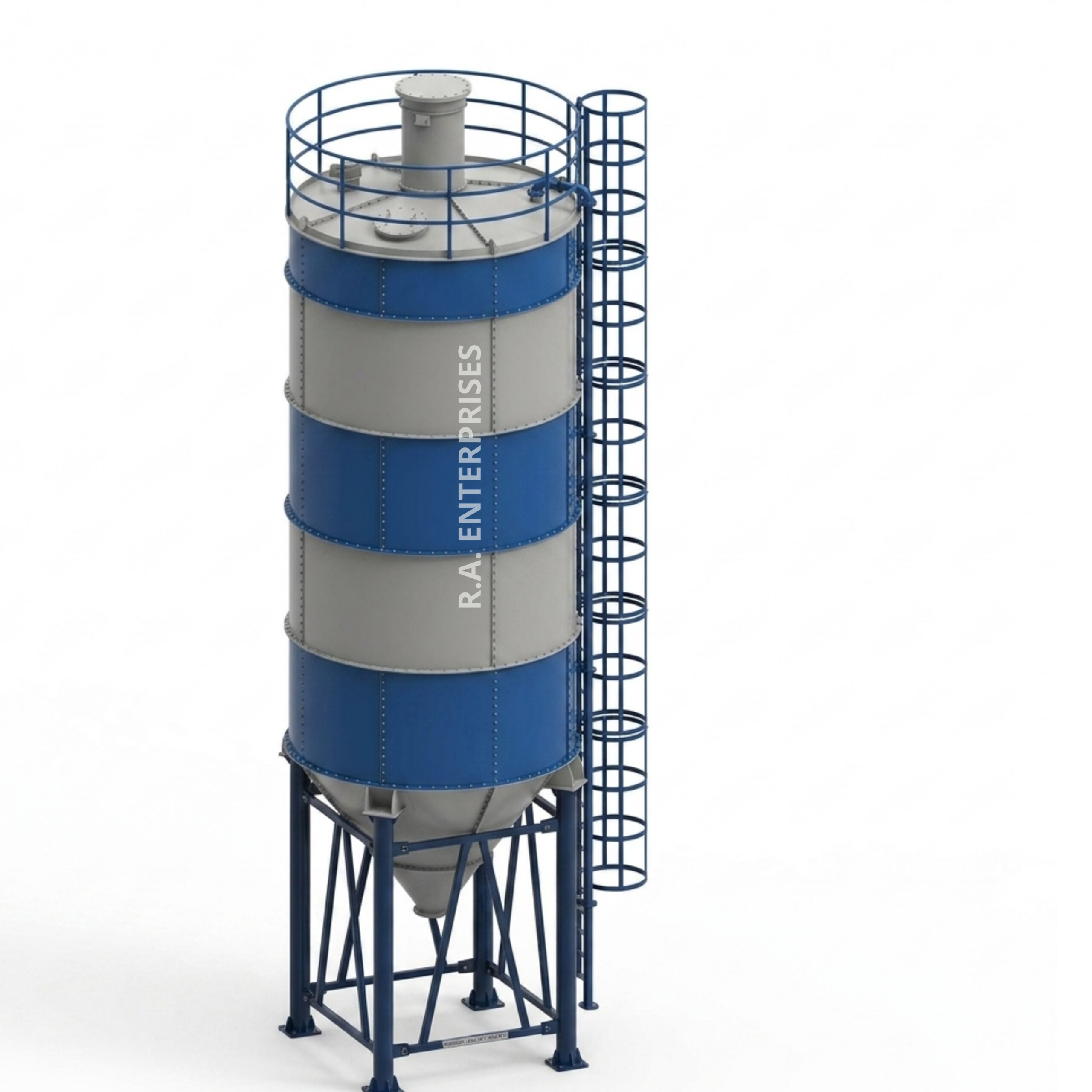
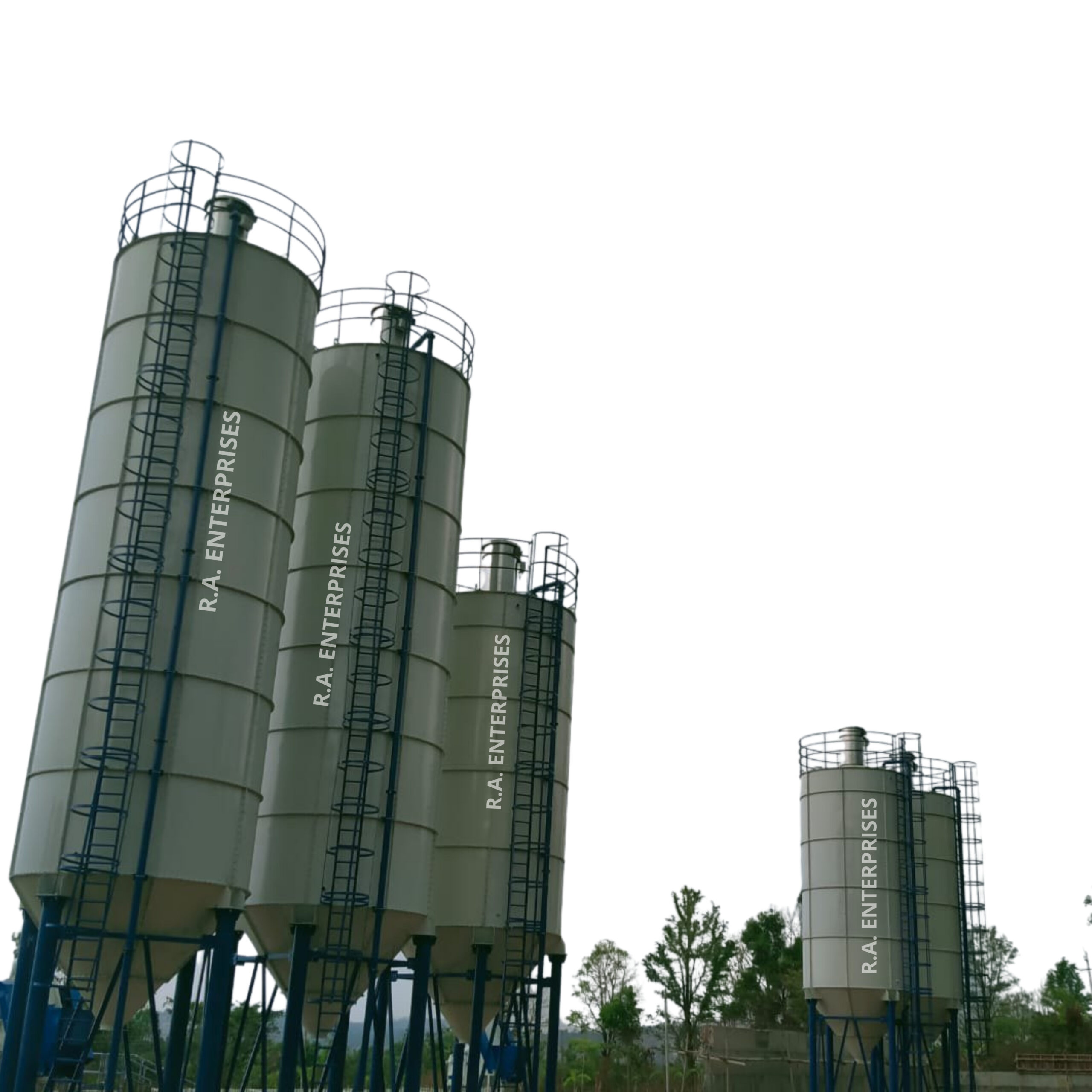
R.A. Enterprises bolted silo manufacturer in pune manufactures custom bolted storage silos for cement, fly ash and dry bulk powder storage in RMC plants, batching plants, cement plants and industrial material-handling system.
The product is configured with bolted Mild Steel shell panels, roof, cone, stiffeners, support legs, base frames, gaskets and high-tensile fasteners and can be supplied in various storage capacity It is suitable for RMC batching plants, cement storage terminals, and precast concrete plants.
Key Features and Advantages
- Modular Design for Logistics: Constructed from panels rather than solid structures, these silos can be easily transported worldwide. They are packed efficiently to minimize shipping costs.
- Durable Construction: Available in carbon or stainless steel, the panels are prepared in protective metallic frames to prevent damage during transit, loading, and unloading.
- Simplified Assembly: Designed for on-site assembly, these systems require short installation times. Certain models can be partially pre-assembled using only a forklift, reducing the need for heavy crane equipment until the final erection phase.
- Safety and Compliance: Engineered to meet all relevant international safety regulations for bulk storage, these structures are built to withstand environmental factors, including wind, snow, and seismic activity in various risk zones.
- Customization and Accessories: Silos can be personalized with specific colours and branding. They are also compatible with a wide range of high-quality accessories, such as ladders, roof rails, valves, and filters, to ensure operational efficiency.
- Cost-Effectiveness: Their modular nature, combined with rapid assembly and low maintenance requirements, provides a significant reduction in overall project costs.
Bolted Storage silo Main Feature and application
-
Main Features:
• Modular panels for transport and site assembly
• Bolted joints with sealing arrangement
• Replaceable or serviceable panel construction
• Provision for inlet, outlet and vent connections
• Accessory mounting provisions as per approved GA drawing
• Custom support-leg and discharge-height arrangement
• Surface preparation and finish to confirmed specification
• Designed against approved load and site inputs -
Applications:
• RMC batching plants
• cement storage terminals
• precast concrete plants
• construction project sites
• fly ash handling systems
• dry powder storage installations
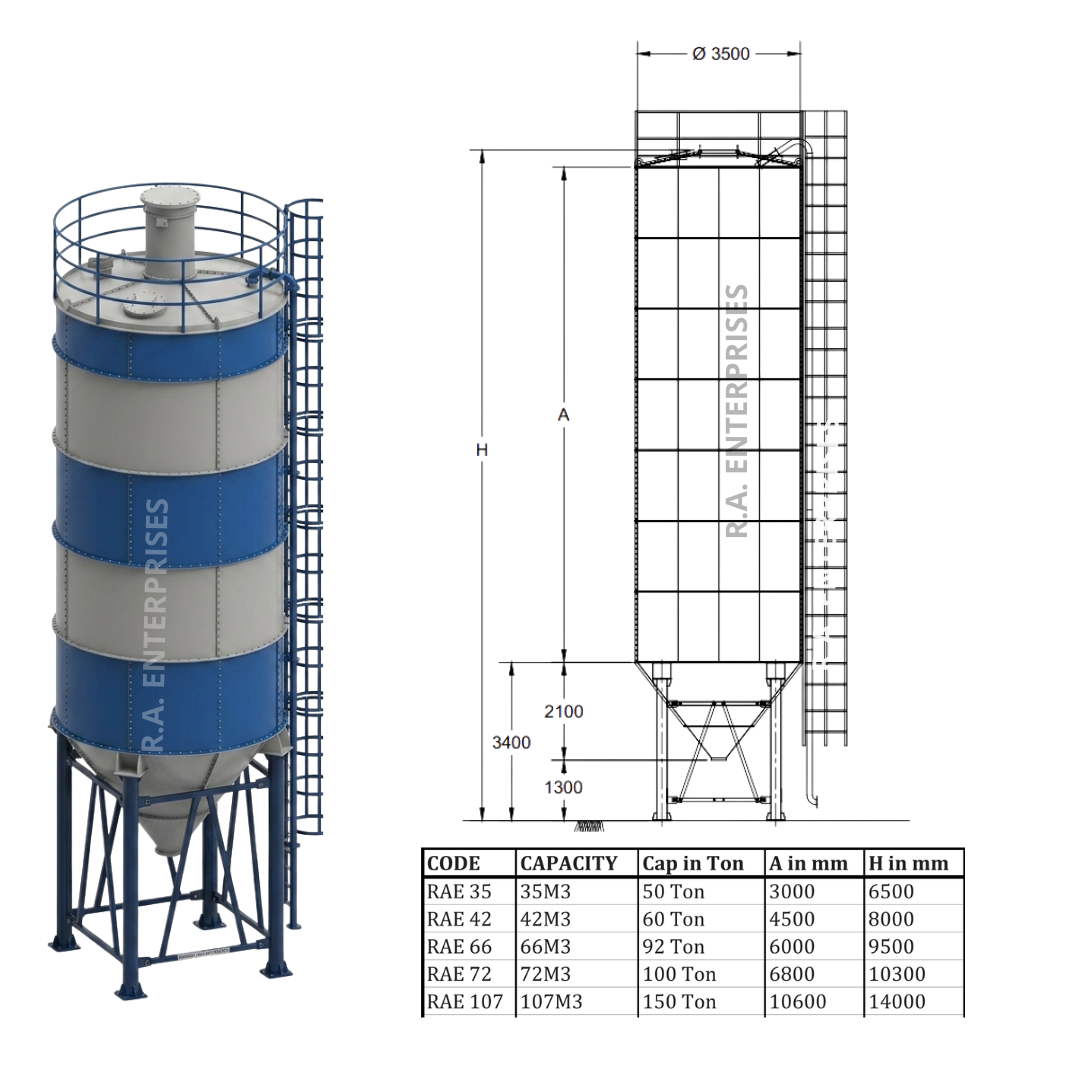
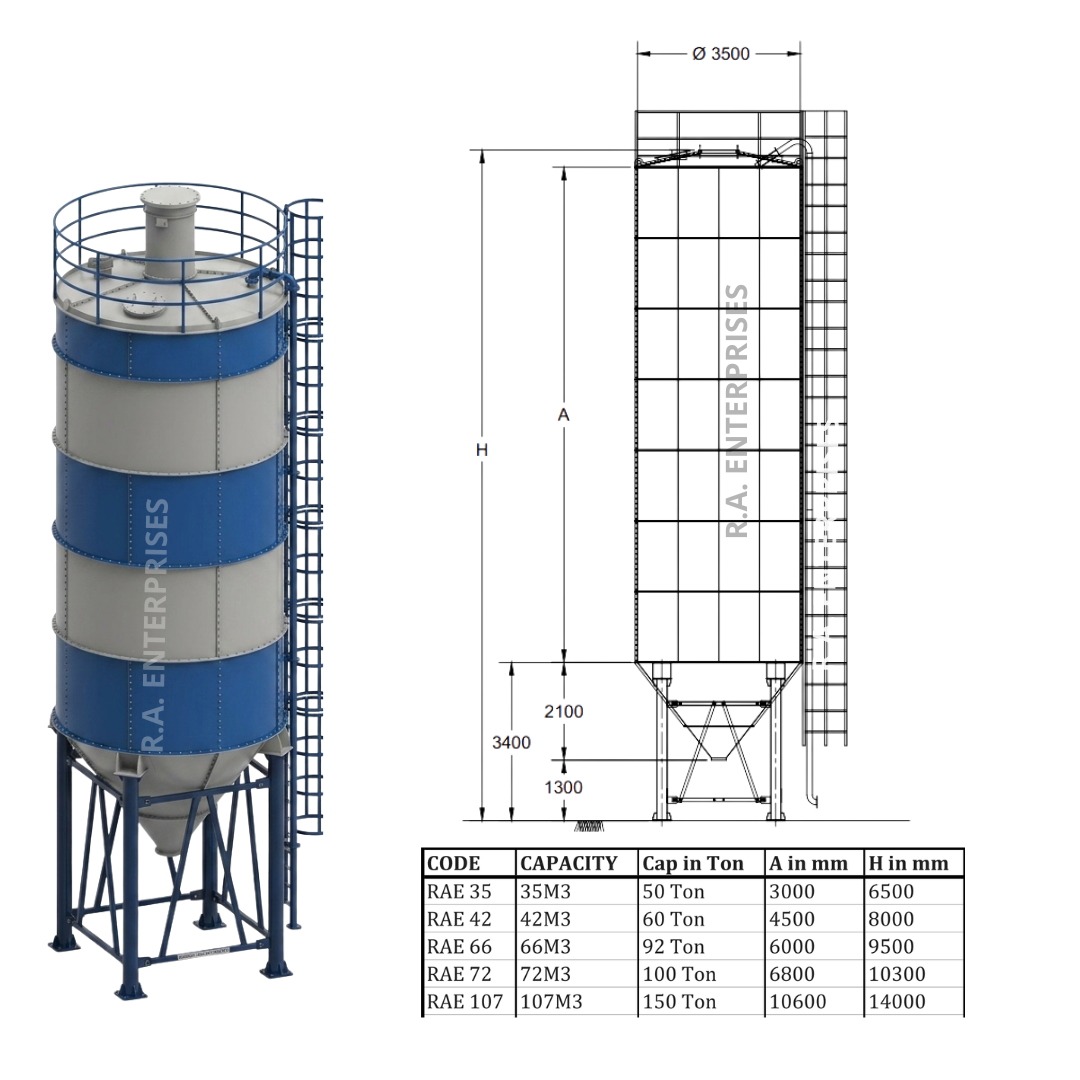
Bolted Storage silo dimension table and technical Specifications

Manufacturing Palletization & Pre-Dispatch Preparation
Enquire Now
Submit your inquiry and receive a prompt response from our technical team.
Frequently Asked Questions About Bolted Storage Silos
Answers to common questions about bolted storage silos for cement, fly ash and industrial dry bulk powder storage in RMC plants, batching plants and material-handling applications.
1. What is a bolted storage silo?
A bolted storage silo is manufactured from prefabricated shell sections or panels that are transported to the project location and assembled using bolted connections. This modular construction is particularly suitable where transporting a large fully fabricated silo would be difficult. Bolted silos can be designed for cement, fly ash and other compatible dry bulk materials.
2. What materials can be stored in a bolted silo?
Bolted industrial storage silos can be designed for cement, fly ash, lime, minerals and various dry industrial powders. The correct silo configuration depends on bulk density, flow characteristics, moisture sensitivity, filling method, discharge arrangement and required storage volume.
3. What is the difference between a bolted silo and a welded silo?
A bolted silo is manufactured in modular sections and assembled at the installation site, which can make transportation of larger silos more practical. A welded silo has more of its structure permanently joined by welding before dispatch. Selection depends on capacity, transport restrictions, site access, installation requirements and project location.
4. How do I select the correct bolted silo capacity?
Silo capacity should be selected after considering material bulk density, daily consumption, delivery frequency, required buffer stock, batching-plant production capacity and available site space. Nominal tonnage alone should not be used to determine the final silo size.
5. What is the price of a bolted cement or fly ash silo?
Bolted silo pricing depends on storage capacity, steel requirement, material specification, plate thickness, support structure, surface finish, accessories, transportation and installation scope. An accurate quotation can be prepared after reviewing the required capacity, stored material and project conditions.
6. What information is required for a bolted silo quotation?
Provide the required storage capacity, material name, approximate bulk density, project location, required discharge height, filling method, discharge or feeding arrangement and required accessories. Existing GA drawings, plant layouts and site photographs are also helpful when the silo must integrate with an existing plant.
7. Can bolted silos be used for both cement and fly ash?
Yes. Bolted silos can be engineered for cement or fly ash storage. However, the actual stored material must be identified because bulk density, flow behaviour, aeration, filtration and discharge requirements may differ between cement and fly ash.
8. Can R.A. Enterprises manufacture a customized bolted silo?
Yes. R.A. Enterprises can evaluate customized bolted silo requirements based on storage capacity, material characteristics, available installation space, interface dimensions and project requirements. Customer drawings, GA drawings and plant layouts can be reviewed before final manufacturing details are confirmed.
9. What accessories are normally required with a bolted silo?
Typical silo accessories can include a dust collector or vent filter, pressure relief valve, high and low level indicators, butterfly valve, aeration or fluidization system, filling pipe, inspection access, ladder, platform and screw conveyor. The final accessory package depends on the application.
10. Can a new bolted silo be connected to an existing RMC or batching plant?
Yes. A bolted storage silo can be designed for integration with an existing RMC or batching plant when the required interface information is available. Important details include discharge height, screw conveyor position, weighing hopper connection, filling-pipe arrangement, available space and foundation conditions.
11. What information is required for bolted silo foundation planning?
Foundation planning requires the final silo configuration, support-leg arrangement, loading information and relevant site conditions. Foundation bolt locations, base plates and template plates should correspond with the approved silo GA and foundation layout.
12. Why can pressure increase inside a cement silo during filling?
During pneumatic tanker unloading, both material and conveying air enter the silo. The displaced air must escape through the correctly sized and functioning venting and filtration system. Restricted venting, blocked filter elements or unsuitable filling conditions can contribute to excessive internal pressure.
13. Why does cement or fly ash dust come out during tanker unloading?
Visible dust during pneumatic silo filling can be associated with blocked or overloaded filter elements, inadequate filter cleaning, poor sealing, unsuitable venting or incorrect filling conditions. The complete filling and filtration system should be inspected when persistent dust emission occurs.
14. Why is an aeration or fluidization system used in a silo?
Aeration or fluidization systems help suitable dry powders move toward the silo discharge outlet and can reduce flow problems such as bridging or poor discharge. The required system depends on the stored material, cone geometry and discharge arrangement.
15. What is the purpose of a silo level indicator?
Silo level indicators are used to detect material-level conditions. A high-level indicator can assist in identifying when material is approaching the required filling level, while a low-level indicator can indicate when additional material may be required. Level signals may also be integrated with the plant control system.
16. Can bolted storage silos be manufactured in MS or SS?
Material of construction should be selected according to the stored product, corrosion environment, operating conditions and project specification. Mild steel is commonly considered for many industrial dry-powder applications, while stainless steel may be selected where the application requires it.
17. How is a bolted storage silo transported and installed?
Bolted silos are manufactured in transportable panels and sections, packed for dispatch and assembled at the project location. This modular approach can make transportation of larger-capacity silos more practical. Site planning should consider unloading, assembly space, lifting arrangements, access and foundation readiness.
18. What drawings should be finalized before manufacturing a bolted silo?
An approved General Arrangement drawing should normally establish the silo dimensions, support arrangement, discharge elevation, connections and major equipment interfaces before fabrication. Foundation details and accessory connections should also be coordinated with the approved silo configuration.
19. Can R.A. Enterprises manufacture a replacement silo for an existing plant?
A replacement bolted silo can be evaluated using the existing plant layout, interface dimensions, discharge height, foundation arrangement and material-handling connections. Customers should provide available drawings, site measurements and photographs so compatibility can be reviewed before manufacturing.
20. What maintenance is required for a bolted silo system?
A bolted silo system should be periodically inspected for panel and structural condition, bolted connections, sealing arrangements, filters, pressure-relief equipment, level indicators, aeration components, valves and discharge equipment. Venting and safety equipment should receive particular attention during routine maintenance.
| CODE | CAPACITY | Cap in Ton | A in mm | H in mm |
|---|---|---|---|---|
| RAE 35 | 35 M³ | 50 Ton | 3000 | 6500 |
| RAE 42 | 42 M³ | 60 Ton | 4500 | 8000 |
| RAE 66 | 66 M³ | 92 Ton | 6000 | 9500 |
| RAE 72 | 72 M³ | 100 Ton | 6800 | 10300 |
| RAE 107 | 107 M³ | 150 Ton | 10600 | 14000 |